Importance of treatment
DETOX CHEMICAL TREATMENTS FOR BOILER
The feedwater is composed of makeup water (usually city water from outside boiler room/ process) and condensate (condensed steam returning to the boiler). The feedwater normally contains impurities, which can cause deposits and other related problems inside the boiler. Common impurities in water include alkalinity, silica, iron, dissolved oxygen and calcium and magnesium (hardness). Blowdown, a periodic or continuous water removal process, is used to limit the concentration of impurities in boiler water and to control the buildup of dissolved solid levels in the boiler. Blowdown is essential in addition to Detox chemical treatments.
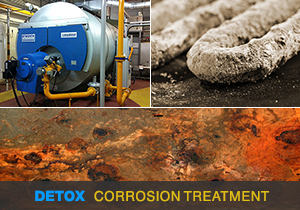
Oxygen attack is the most common causes of corrosion inside boilers. Dissolved oxygen in feedwater can become very aggressive when heated and reacts with the boiler’s internal surface to form corrosive components on the metal surface. Oxygen attack can cause further damage to steam drums, mud dams, boiler headers and condensate piping.
Acid attack is another common cause of corrosion. Acid attack happens when the pH of feedwater drops
below 8.5. The carbonate alkalinity in the water is converted to carbon dioxide gas (CO2) by the heat and
pressure of the boilers. CO2 is carried over in the steam. When the steam condenses, CO2 dissolves in
water to form carbonic acid (H2CO3) and reduces the pH of the condensate returning to the boilers. Acid
attack may also impact condensate return piping throughout the facility